
 CLdN Heysham-Warrenpoint 6-7 February 2025
06 February 2025


The surveyors met at 7.45am at the CLdN office and were then efficiently transferred onto the Point for the sailing across to Warrenpoint. After having a hearty breakfast provided while the ship left Heysham dock we were escorted to the bridge to begin our survey.
The weather during the day was bright but overcast which made visibility perhaps not as good as it could have been, and picking out colours on birds was sometimes difficult. Unusually, on both days there was almost no swell but the sea was quite rough with plenty of white water and breaking waves, making it harder to see birds.
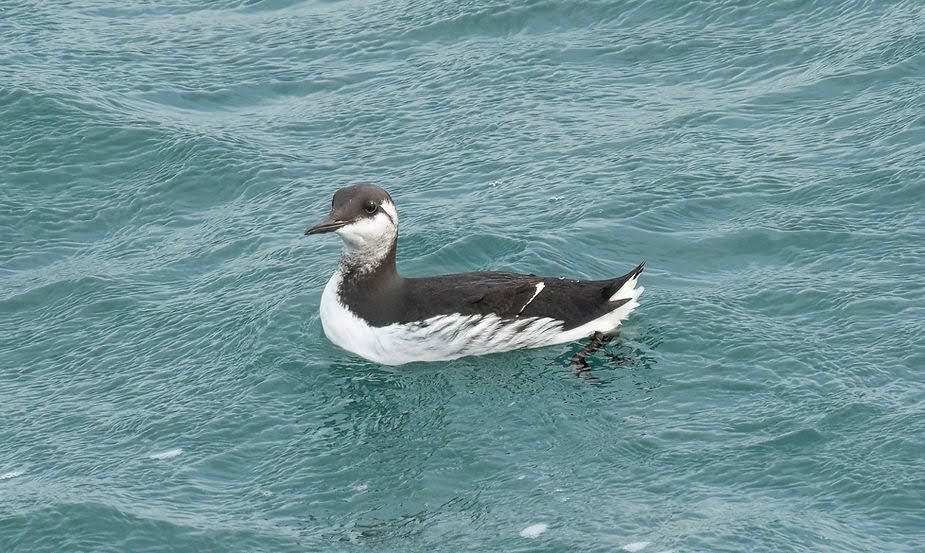
Before reaching the wind turbine area we saw several Herring Gull and Common Gull and a few Black-headed Gull. Guillemot occurred in ones and twos throughout the survey and were just beaten by Kittiwake to be the most frequently seen seabird during the survey. Guillemot greatly outnumbered Razorbill during the survey, which is normal for these surveys. Unusually, only one Gannet was seen during the first day and very few Fulmar.
During the afternoon the sun burst through the clouds intermittently for a while and created a wide variety of colours in the sea from pale turquoise to dark slate grey. Part way between the Isle of Man and Ireland a fishing vessel was spotted several kilometres away, with several hundred gulls of a variety of sizes and species following it, rather more than the total number of birds seen during our survey but too far away for these birds to be included! However, towards the end of the day a group of three non-breeding plumage Puffin were seen.
We finished the first day’s survey just before the Haulbowline Lighthouse and enjoyed another hearty meal as the sun set before disembarking and walking to the Whistledown Hotel. The only mammal seen on the first day was a seal illuminated by the lights of Warrenpoint harbour.
It was dark when we arrived and just getting light when we left in the morning, so our sea view rooms were rather wasted on us, but the thought was appreciated. We enjoyed the usual Irish breakfast before a brisk walk back to the CLdN office for transfer onto the Performance.
White waiting for the ship to embark, we took the opportunity was taken to watch a flock of Light-bellied Brent Geese and various waders feeding on the shore on the other side of the river, and shortly after departure we were escorted onto the bridge to start our second day’s survey.
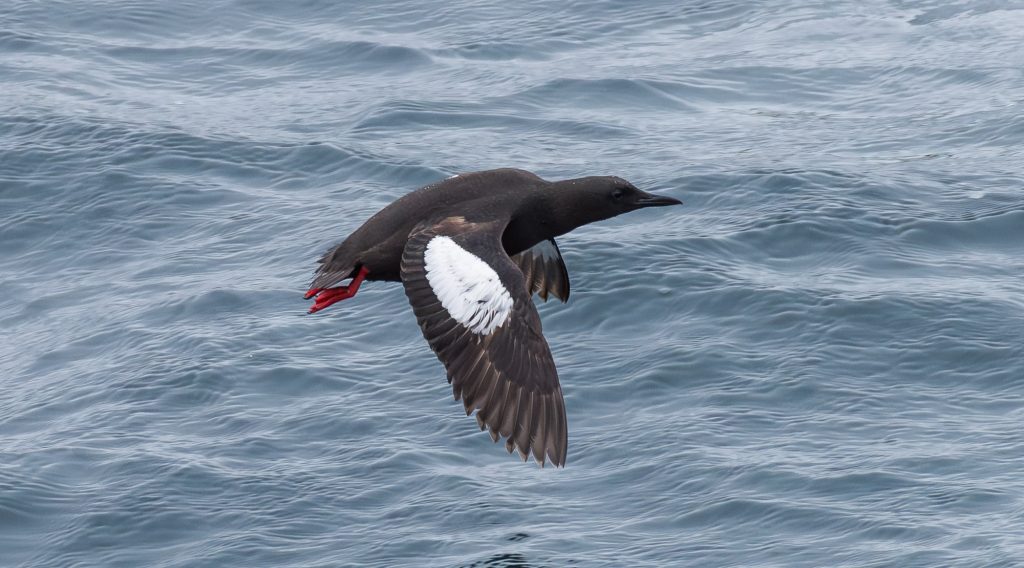
By now there was sufficient light to be able to observe birds although there was significant glare from the sun straight ahead of us as we sailed down Carlingford Lough. There were small groups of waders along the coast towards the mouth of the lough, and where the waters were more disturbed there were numbers of Shag and Cormorant feeding together with several Red-breasted Merganser. Many more Cormorant and Shag were resting on the low islands near the lighthouse, but surprisingly no seals were spotted on the islands or in the water. However, several Black Guillemot were in evidence, and like several of the other species some were already in breeding plumage while most were still in their winter, non-breeding plumage.
We noted that the wind was considerably stronger than the previous day, so any hopes of better views of birds and cetaceans on the return survey were considered unlikely. Even though there was almost no swell there were plenty of waves and white caps creating a very busy image of the sea and making spotting birds more difficult, and cetaceans could easily have passed un-noticed in the waves.

We were treated to close views of a couple of Great Northern Diver and a single Red-throated Diver just out from Carlingford Lough, but for the rest of the survey we generally saw only occasional lone Guillemot and Kittiwake with a few Razorbill and Common Gull.
Highlights of the return survey were a small flock of Common Scoter, and while we were following a circling Lesser Black-backed Gull, it dropped into the water by a Grey Seal, which it had had obviously seen before we saw it. Two Common Gull feeding on a dead sheep floating in the sea was a rather less pleasant sight.
We finished the survey in time for a meal before disembarking and making our way home. Even though this was a relatively quiet crossing for wildlife, every survey generates new information even if that is of low numbers for what are generally regarded as the more common species.
We are grateful to CLdN, Captains Butrymowicz and Sinimae and all their staff, and the CLdN ground staff for their efficiency and help during this survey and for allowing the surveys to take place.
Robin Langdon and Tony Marshall, Research Surveyors for MARINElife (Registered Charity No. 1110884; Registered Company No. 5057367)
Weather
Outward – overcast, reasonable visibility: Wind E, sea state 4-5.
Return – Cloudy with sunshine at times, good visibility: Wind E, sea state 6-7.
Summary of sightings
Seabirds
Auk sp. Alcidae 7
Black-headed Gull Chroicocephalus ridibundus 10
Black-throated Diver Gavia arctica 1
Common Gull Larus canus 39
Common Scoter Melanitta nigra 5
Cormorant Phalacrocorax carbo 1
Fulmar Fulmarus glacialis 18
Gannet Morus bassanus 3
Great Black-backed Gull Larus marinus 6
Great Northern Diver Gavia immer 2
Guillemot Uria aalge 90
Herring Gull Larus argentatus 37
Kittiwake Rissa tridactyla 91
Large gull sp. Larus sp. 29
Lesser Black-backed Gull Larus fuscus 8
Puffin Fratercula arctica 5
Razorbill Alca torda 26
Red-throated Diver Gavia stellata 1
Shag Gulosus aristotelis 2
Birds in Carlingford Lough and Warrenpoint
Black Guillemot Cepphus grylle
Black-headed Gull Chroicocephalus ridibundus
Brent Goose Branta bernicla
Common Gull Larus canus
Cormorant Phalacrocorax carbo
Curlew Numenius arquata
Dunlin Calidris alpina
Great Crested Grebe Podiceps cristatus
Great Black-backed Gull Larus marinus
Herring Gull Larus argentatus
Hooded Crow Corvus cornix
Oystercatcher Haematopus ostralegus
Red-breasted Merganser Mergus serrator
Redshank Tringa totanus
Shag Gulosus aristotelis
Marine Mammals
Grey Seal Halichoerus grypus 1
