
 CLdN Heysham to Dublin 11 August 2026
11 August 2026


Good opportunities are not always easy to come by, and mind-blowing ones are extremely rare. This was my first survey for MARINElife, and as I settled into my comfortable cabin on the CLdN Power little did I realise what I was about to experience.
We took to the bridge after a short sleep and generous breakfast laid on by the ship’s steward. With the Power sailing between the Isles of Anglesey and Man we settled to surveying in earnest. The hours spent reading the survey protocol before the survey were well justified given that there was little time for any on-ship training during the survey between the numerous seabird sightings!

Manx Shearwater, Kittiwake, Fulmar, and Gannet were frequent, with occasional Storm Petrel. In the early morning light, a large group of Herring Gull and Lesser Black-backed Gull of mixed ages hitched a lift on the trailer units on the upper deck level. Auks were in abundance too, with Guillemot regularly in sight with the odd Razorbill or two tagging along, while at a quiet moment there was also a solitary Puffin sitting idle in the lee of the waves.
Unfortunately, we didn’t happen upon any cetaceans by the time we entered Dublin harbour although we did see a Grey Seal hogging the ship’s docking space.

While the ship carried on with its turnaround offloading and loading return freight in Dublin, we took a well-earned break and had a good hearty lunch, and the steward and bridge crew were kind and engaging, excellent in making sure our needs were met.
The return leg of the survey from Dublin back to Heysham saw the pace of seabird activity at first less intense than in the morning crossing. However, this started to change as we approached the sea area between Anglesey and the Isle of Man when seabird sightings started to build, though not quite as frequent as the morning’s avian commuter rush, but still great for recording and learning.
Luckily both passages gave us the sun at our backs and so with little glare. The sunlight nicely picked out the lighter plumages of the birds and also the patterns on the flanks of the cetaceans, allowing for ease of identification. Throughout the return journey there were feeding groups of mixed seabirds both at distance from the vessel and closer in, becoming regular inside the survey box, and we hoped that in time these feeding episodes would draw in those very cetaceans that eluded us earlier in the day.
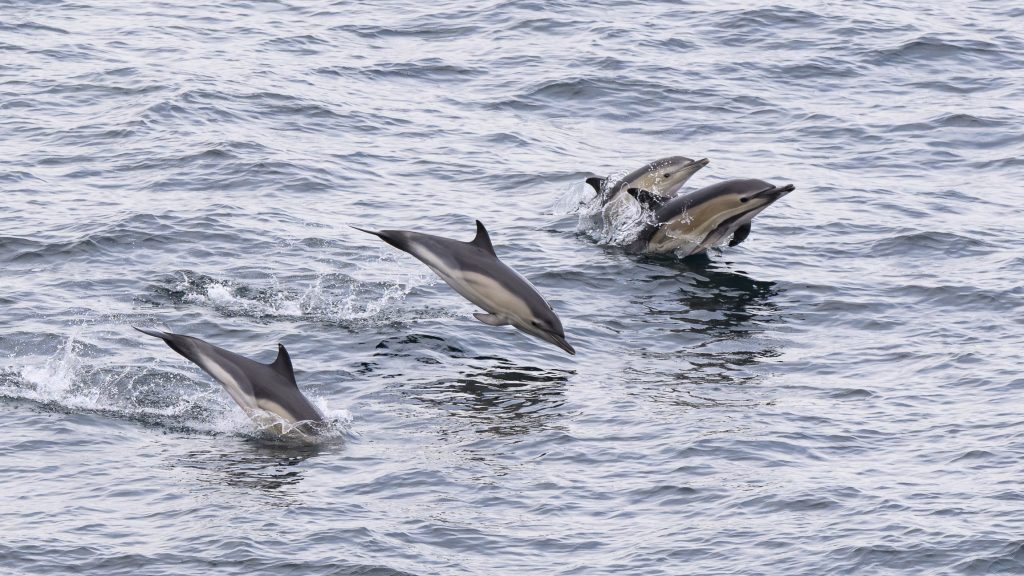
And then it happened, just like of TV! – my first sighting of Common Dolphin, not just a few but loads of them! The animals cruised through the gathered birds, leaping and splashing high and low, with some spectacularly bursting from the water to splash down on their sides, flushing the birds to either side – mind blowing! At the time of writing, I believe there were two groups that approached the same feeding site, and soon after individuals and small groups were seen sporadically with the odd Harbour Porpoise both close to the ship and more distantly outside of the survey box and behind in the wake of Power’s wake.
With our arranged dinner time fast approaching, we both acknowledged the niggle in our minds that if we went for dinner now, we would miss something great or many something greats. Those thoughts simmered menacingly in the forefront of our minds, but as the stewards had done us the courtesy and kindness in preparing our meal, we dropped down the couple of decks to the dining room, where a wonderful mix of Eastern European delights such a borsht and pierogi with a side of spaghetti bolognaise were waiting for us, and all very well prepared and welcome!
As we enjoyed our meal, I had that urge to look over my shoulder. This desire gripped me and I succumbed, and I could not resist to turn and look through the window towards the bow. What I saw was a scene of action – a group of seabirds were gathered about a clutter of sea water just on front of the advancing ship, and at the last second as the Power powered through that bait shoal there appeared as the icing on the cake, several dolphins breaking the water and chasing down their feast. I was ecstatic and a little hyper, so we finished our meal quickly and returned to the bridge, where we immediately saw three Common Dolphin heading away to starboard, ninety degrees out from the ship’s bow.
After this, we were regularly treated with sightings of Common Dolphin, with there being sightings of individuals, small groups, larger pods, and even multiple groups in extended pods. Harbour Porpoise were spotted in much smaller groups of two and three as well as lone individuals. The task every 15 minutes of recording of position and conditions became something of a distraction and even minor hinderance to our efforts to spot and identify the continued passage of cetaceans (Editor’s note: though an absolutely necessity!)
The recording of these prolific cetacean sightings was such that recording seabird activity was having to take second place to the cetacean paperwork which necessarily took priority, although we adhered to best practice when we could.
This was my first trip as a surveyor for MARINElife and I realised I need to tidy up my seabird identification with regard to juvenile gulls and gulls in general, and recording mixed groups of sea birds. (Editor’s note: This learning process never stops for all of us!)
Sadly, all good things come to an end, and as we reached the outer waters of Morecambe Bay the light and visibility began to degrade, although there were still a few sightings of Harbour Porpoise. Mist started to build and the sea state flattened nearly to a dead calm with areas of flat water that had a strange juddering vibrating texture to the surface. Soon, failing light and increasing mist stole our viewing pleasure, and we reluctantly brought the survey to an end and returned to the passenger lounge to tidy up our paperwork.
What an amazing sea bird and marine wildlife experience this was! As a novice I certainly managed to tick a few boxes and see sights that I never dreamt would be possible. Thank you very much to Tony Marshall for his guidance and support, to the MARINElife team for giving me this opportunity, but mostly to CLdN and especially Captain Lukasz Kurach and the crew of the Power, who were quite frankly impeccable.
James Nock and Tony Marshall, Research Surveyors for MARINElife (Registered Charity No. 1110884; Registered Company No. 5057367)
Weather
Outward – Wind east to south easterly variable 4 – 12 knots, sea state 1, swell 0, excellent visibility.
Return – Wind south easterly dropping then north-easterly, 25 knots dropping to less than 10 knots by 6pm, sea state 3 improving to 1, swell 0, excellent visibility becoming overcast for last hour of survey.
Summary of sightings
Seabirds
Auk sp. Alcidae 16
Commic Tern Sterna hirundo/Sterna paradisaea 3
Common Gull Larus canus 1
Common Tern Sterna hirundo 17
Cormorant Phalacrocorax carbo 16
Fulmar Fulmarus glacialis 21
Gannet Morus bassanus 127
Great Black-backed Gull Larus marinus 5
Guillemot Uria aalge 883
Gull sp. Laridae 764
Herring Gull Larus argentatus 259
Kittiwake Rissa tridactyla 87
Lesser Black-backed Gull Larus fuscus 53
Manx Shearwater Puffinus puffinus 959
Mediterranean Gull Ichthyaetus melanocephalus 2
Puffin Fratercula arctica 4
Razorbill Alca torda 20
Sandwich Tern Thalasseus sandvicensis 1
Shag Phalacrocorax aristotelis 1
Storm Petrel Hydrobates pelagicus 6
Tern sp. Sternidae 4
Marine Mammals
Common Dolphin (Short-beaked) Delphinus delphis 79
Grey Seal Halichoerus grypus 2
Harbour Porpoise Phocoena phocoena 12
