
 CLdN Heysham to Warrenpoint 5-6 March 2026
05 March 2026


I arrived at Heysham early and with CLdN assistance quickly negotiated the new port access system and was therefore early onto the ship, where after a welcome breakfast I was escorted onto the bridge. Just outside the port entrance there were several groups of Wigeon feeding and four Light-bellied Brent Geese flew past.
Once on the bridge there was hardly time to get the survey forms organised before encountering the first large mixed flock of gulls, so this was a good start to the survey. After that, small numbers of Kittiwake and Guillemot were seen, with a few were changing into their breeding plumage. Despite the almost continuous clouds, a break in the cover allowed a Gannet to fly past in full sun – a glorious sight!
A feature of the day’s survey was the weather, which was more varied in the space of a few hours than I have encountered on previous surveys. It was sunny and calm briefly to start the day with hazy cloud and poor visibility and an almost calm sea by late morning, but after passing the Isle of Man this quickly changed to heavy rain and high winds giving a much livelier sea! The ship’s motion hardly changed but the sea state and ship’s instruments indicated the abrupt change.
Although no Manx Shearwater were seen this time there was a reminder of spring as a small flock of little brown pipit-like birds were seen flying towards the Isle of Man.

In the earlier calm seas, a Harbour Porpoise was seen, followed by sightings of two small pods of Common Dolphin. With the Irish coast in sight a Little Gull was observed with two Kittiwake, and then as the Progress approached the Haulbowline Lighthouse two Great Northern Diver were spotted among the few Cormorant and Shag. Two Black Guillemot were swimming just to seaward of the lighthouse and a Gannet flying past was the last bird seen on the first day’s survey.
After an excellent meal on board, the Progress docked at its berth, and I had my usual walk round the coast to the Whistledown Hotel, unfortunately in light rain! The rain stopped in time for a dusk walk along the head of Carlingford Lough with more shore visible than usual due to a low spring tide, and where an early Greenshank was a welcome sight.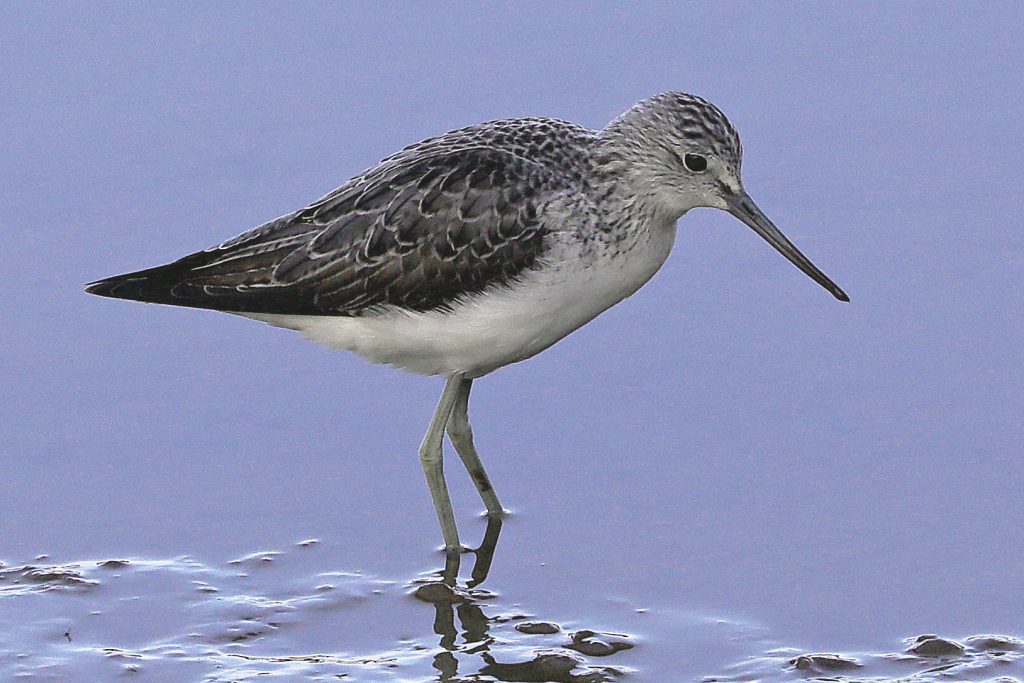
Greenshank (photo: Rob Petley-Jones)
The following morning dawned bright, clear, and sunny, and Carlingford Lough was almost mirror calm. After the usual excellent breakfast at the Whistledown Hotel, made special this time by the views down the Lough with Light-bellied Brent Geese feeding along the water’s edge, it was time for a brisk walk back to the dock.
I was quickly escorted up to the bridge where I received the usual very friendly welcome, and after a few minutes waiting for the tide to rise we were able to leave the Lough and the return survey started as we passed the Haulbowline Lighthouse. There were many more Cormorant and Shag on the skerries at the entrance to Carlingford Lough, together with a couple of Grey Seals.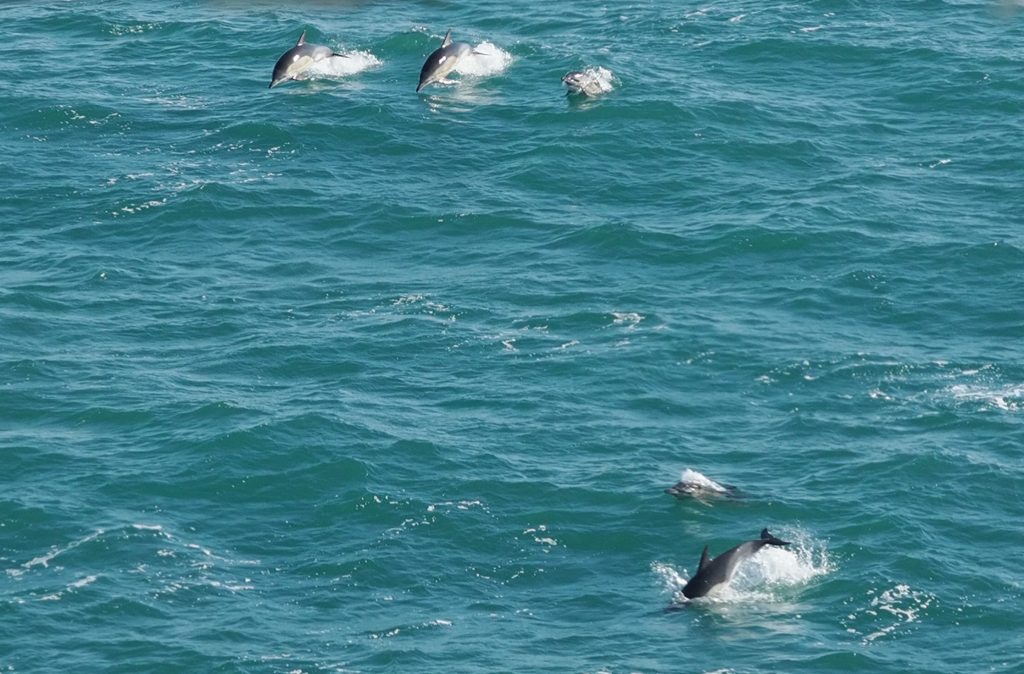
Common Dolphin pod (photo: Tony Marshall)
Soon after lunch I was fortunate to see a large pod of at least 20 Common Dolphin heading for the ship – a wonderful sight. Then after a couple of hours with very few birds being seen, it seemed like a good time for a brief break before the final survey session of the day. Frustratingly, a glance over the sea about ten minutes into this rest period revealed a large flock of gulls so the break was stopped in order to get some idea of their numbers. Inevitably the identification had to be more general than would have been the case if the flock had been spotted while it was more distant!
Towards the Fylde coast many more gulls were seen, including a Little Gull, occasional Lesser Black-backed Gull, and several Common Gull in with the numerous Herring Gull.
During the survey only a few Razorbill and a couple of Puffin were seen, well outnumbered by Guillemot. Unusually there were very few sightings of Fulmar but Gannet were seen regularly, presumably moving back to their nesting sites.
My thanks go as usual to the ship’s captains and crews of the Progress and Precision, and to the CLdN ground staff for all their help and friendliness when getting be to and from the vessels. It is aways a privilege to be able to undertake these surveys but everybody’s welcome and assistance also makes these trips a very pleasurable activity.
Tony Marshall, Research Surveyor for MARINElife (Registered Charity No. 1110884; Registered Company No. 5057367)
Weather
Outward – Overcast, poor visibility, sea state 4 dropping to 1 then 6 during heavy rain in afternoon.
Return – Sunny, good visibility: sea state 3.
Summary of sightings
Seabirds
Auk sp. Alcidae 16
Black Guillemot Cepphus grylle 2
Common Gull Larus canus 23
Cormorant Phalacrocorax carbo 4
Cormorant/shag sp. Phalacrocoracidae 1
Fulmar Fulmarus glacialis 4
Gannet Morus bassanus 32
Great Black-backed Gull Larus marinus 4
Great Northern Diver Gavia immer 2
Guillemot Uria aalge 90
Herring Gull Larus argentatus 231
Kittiwake Rissa tridactyla 90
Larus sp. Larus sp. 173
Lesser Black-backed Gull Larus fuscus 7
Little Gull Hydrocoloeus minutus 4
Puffin Fratercula arctica 2
Razorbill Alca torda 11
Shag Phalacrocorax aristotelis 6
Birds recorded in Carlingford Lough and Warrenpoint
Black Guillemot Cepphus grylle
Black-headed Gull Chroicocephalus ridibundus
Cormorant Phalacrocorax carbo
Great Black-backed Gull Larus marinus
Great Crested Grebe Podiceps cristatus
Greenshank Tringa nebularia
Grey Heron Ardea cinerea
Herring Gull Larus argentatus
Hooded Crow Corvus cornix
Light-bellied Brent Goose Branta bernicla
Mallard Anas platyrhynchos
Oystercatcher Haematopus ostralegus
Redshank Tringa totanus
Shag Gulosus aristotelis
Wigeon Anas penelope
Terrestrial Birds
Pipit Sp. Anthus sp. 9
Marine Mammals
Common Dolphin (Short-beaked) Delphinus delphis 38
Harbour Porpoise Phocoena phocoena 1
