Having departed Felixstowe in the early hours of the morning, dawn found us well on the way to the Netherlands, approximately two hours from the Dutch coast. Taking up my position on the starboard side of the bridge, I prepared to begin the survey in overcast conditions with moderate winds and a corresponding sea state, with numerous whitecaps topping the waves.
I took the first set of readings from the ship’s instruments (location, ship’s course and speed, wind speed and direction) and was just assessing the sea state, height of swell and visibility when a small flock of Common Scoter flew across the bow of our vessel, heading south. These dark, rotund sea ducks are recorded in large numbers in the North Sea and around the British and Irish coasts on migration. Britain and Ireland have small breeding populations and most of the birds sighted around our coasts and out to sea breed elsewhere, including Scandinavia and other areas of Northern Europe.

Aside from this initial encounter, no birds were recorded for the first hour of the survey. The second sighting was actually a slightly larger flock of the same species, again heading south, shortly followed by the first few Gannets of the day.
Nearing the Dutch coast, the ship slowed as we entered the Maas River for the final part of our outward journey, a carefully navigated stretch of river leading up to the port of Vlaardingen, which lies just west of Rotterdam. Here we began recording large numbers of coastal and other wetland birds, including Herring Gull, Great Black-backed Gull, Lesser Black-backed Gull, Black-headed Gull, Common Gull, Gadwall, Wigeon, Coot, Lapwing, Oystercatcher and hundreds of Cormorant.
As we neared Vlaardingen, I ceased recording, left the bridge and went below to wait for a few hours until we set sail again for the return journey. I took the opportunity to have a close look at the gulls which gathered around the vessel as she manoeuvred into our mooring, and spent some time practising my identification skills on immature birds.
Having been unloaded and loaded once more, Suecia Seaways set off for the return journey to Felixstowe and I made my way back up to the bridge for the last part of the survey.
During the hour or so it takes to motor down the river, the same bird species were recorded as during the first leg of the survey that morning. Emerging from the sheltered mouth of the river, I kept a sharp eye out for Harbour Porpoise, which are occasionally recorded here, but saw none.
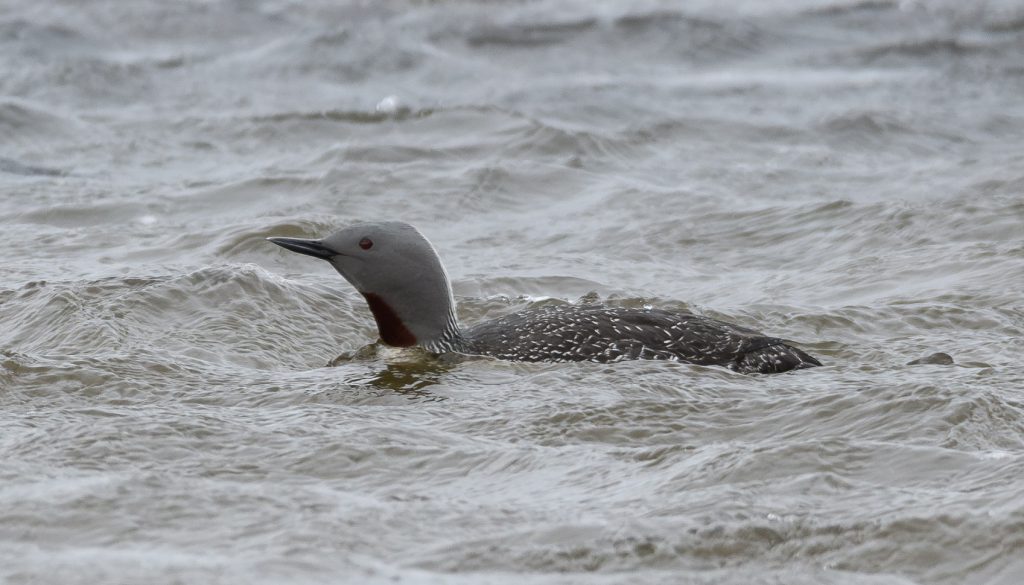
The survey had another hour to run until sunset, during which Gannet and Great Black-backed Gull were the only species encountered, save for the welcome sight of a Red-throated Diver taking flight beside the vessel as we passed.
As the early winter dusk approached and light levels began to fall, I finished recording and retired below for a welcome meal and to read a book about foghorns as I awaited our arrival at Felixstowe.
My thanks go to DFDS, their shore-based staff, Captain Sekjaer and his officers and crew for their hospitality and co-operation in facilitating our survey.
Pat Hatch, Research Surveyor for MARINElife (Registered Charity No. 1110884; Registered Company No. 5057367)
Weather
Outbound – overcast, good visibility, wind NW force 4-8
Return – overcast, good visibility, wind NW force 3-6
Species recorded
Seabirds
- Black-headed Gull Chroicocephalus ridibundus 129
- Common Gull Larus canus 4
- Common Scoter Melanitta nigra 24
- Gannet Morus bassanus 15
- Great Black-backed Gull Larus marinus 14
- Herring Gull Larus argentatus 203
- Lesser Black-backed Gull Larus fuscus 1
- Red-throated Diver Gavia stellata 1
- Larus sp. 12
- Gull sp. 189
River birds
- Coot Fulica atra 25
- Cormorant Phalacrocorax carbo 719
- Gadwall Mareca strepera 20
- Lapwing Vanellus vanellus 46
- Oystercatcher Haematopus ostralegus 3
- Wigeon Mareca penelope 6
- Duck sp. 4