We managed to board the CLdN vessel ‘Power’ by about 01:00 early Tuesday morning in torrential rain and strong winds but we were on the bridge by 06:30 to begin the survey. It was just about bright enough to begin the survey, but the flat light made it difficult to discern some identification features of the birds. However, by 07:30 things had improved considerably.
The sea state on the outward leg was 4-5 with wind speeds of around 25 knots. Thankfully, it was initially calmer on the return leg with the sea state dropping to 4. However, wind speeds eventually increased, backing northerly on the approach to Heysham, where docking was delayed as the wind was dead astern on approach which would have made accessing the narrow harbour mouth difficult.
On the outward leg there were frequent sightings of Manx Shearwater, Guillemot, and Gannet, with occasional Kittiwake, Fulmar, and Herring Gull. At 08:45 we had our only mammal sighting of the trip, when eight Common Dolphin, 6 adults and 2 juveniles, approached the bow from the starboard side giving us good views of them before they passed to the other side. As we approached Dublin we began to have more sightings of Mediterranean Gull, before arriving at the Dublin breakwater at 09.30 in glorious sunshine and a strong wind, when we completed the outward survey. After docking, Captain Karm generously allowed us to stay on the bridge to continue with any other sightings of interest in the port.
Within the port we counted about another 45 Mediterranean Gull amongst the numerous Black-headed Gull and Common Gull, together with large numbers of Common Tern where populations have been encouraged by the nesting rafts. On one of them there were at least 130 terns.
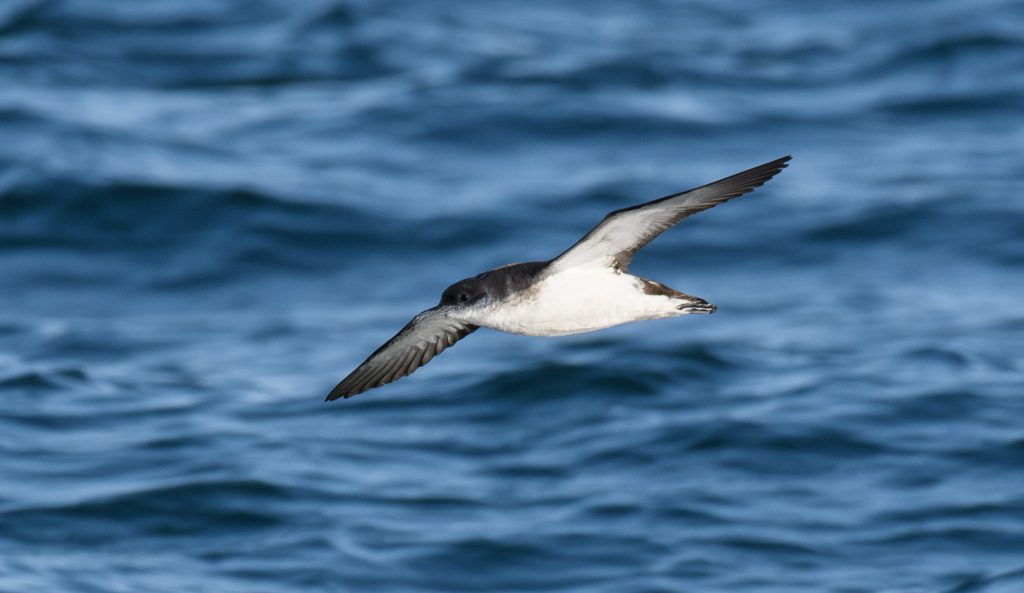
The Power left Dublin at 14.00, and we started surveying again once beyond the breakwater. The sea conditions were a bit calmer than in the morning, but the sky was more overcast. There was a similar mix of bird species on the return leg, but the highlight came at 15:19 when we passed through large rafts of over 500 Manx Shearwater, their position shown by the black cross on the map below. This congregation was just outside the British Fishery Limit boundary and west of the proposed Irish Sea Front Special Protection Area as shown in the red polygon, this SPA identified as an important area of the Irish Sea for Manx Shearwater.

We surveyed from the bridge for as long as the light permitted, but by 19:45 it was too poor to continue and we headed for the comfort of the passenger lounge.
Our thanks to CLdN ferries shoreside staff for escorting us to and from the ship safely and especially to Captain Karm and the crew of the Power for their help and hospitality during the passage.
Weather
Outward (06:30 – 09:30)– Wind south-westerly to westerly variable 18 – 28 knots, sea state 4 -5, swell 0, visibility mostly good with largely clear skies
Return (14:00 – 19:45)– Wind westerly to north-westerly variable 18– 28 knots, sea state 3 to 4, swell 0, visibility good, mostly overcast.
Dave Shackleton and Philip Dutt, Research Surveyors for MARINElife (Registered Charity No. 1110884; Registered Company No. 5057367)
Species recorded
Marine mammals
- Common Dolphin (Short-beaked) Delphinus delphis 8
Seabirds
- Auk sp. Alcidae 3
- Black-headed Gull Chroicephalus ridibundus 6
- Common Gull Larus canus 3
- Common Tern Sterna hirundo 4
- Cormorant Phalacrocorax carbo 5
- Fulmar Fulmarus glacialis 14
- Gannet Morus bassanus 93
- Guillemot Uria aalge 306
- Gull sp. Laridae 2
- Herring Gull Larus argentatus 20
- Kittiwake Rissa tridactyla 31
- Lesser Black-backed Gull Larus fuscus 3
- Manx Shearwater Puffinus puffinus 1134
- Mediterranean Gull Ichthyaetus melanocephalus 27
- Razorbill Alca torda 10
- Shag Gulosus aristotelis 1
- Tern sp. Sternidae 7