
The day started full of promise with a sea state two and groups of shearwaters, including Balearics, scooting past. Unfortunately, that was while we were manoeuvring to get to the start of the transect, once on we had more Manx Shearwaters but no Balearics.
The sight of a first winter Great Black-backed Gull perched on something and pecking away at it got our interest. An adult Great Black-backed Gull and Great Skua were sat nearby – presumably having had their fill as the younger bird was feeding – photo 1. As we drew level, we could see that it was a dead Common Dolphin, it had been dead a while and the shape of the chunks taken out of it suggests sharks had been feeding on it as well as birds.

As we headed further offshore there were few birds to be seen. Last year we had seen large rafts of Great Shearwaters on this transect, and yesterday, just 30km to the west, we had been seeing hundreds of Cory’s and Great Shearwaters but today there was nothing. In the five hours we were on transect we recorded just 148 birds, most of which were in the first hour.
We did at least record Common Dolphins on this transect, although only two encounters with 20 animals.
A small bird had been flitting around off and on during the morning, it finally stayed put long enough to be identified as a Black Redstart, a surprisingly regular visitor to the CEFAS Endeavour on the Peltic surveys, being seen most years.
Bad luck of the day – Minke Whale rolling 200m from the ship about two minutes after we had finished the transect – logging one on transect will have to wait until another day.
There was only a ten-minute break until we started the next transect and just after we had begun the rain started and continued until we finished. Fortunately, the wind was behind us, so the windscreens stayed dry – not that it helped us much, there were still no birds to be seen – we recorded 20 birds in the first three hours of the transect.
Things picked up as we neared land and there was a steady trickle of Gannets and Cory’s Shearwaters, but we still only recorded 119 birds on an 87km long transect. Despite, or perhaps because of, the heavy rain a slightly bedraggled Robin joined us for a time.

We did at least have a good encounter with a pod of 45 Common Dolphins, amongst which were quite a few young calves. Conditions weren’t good for photographs so here’s a photo from an earlier Peltic (photo 2).
Surely things will get better tomorrow.
16th
Hmm, maybe not. One of the worst sights that can greet you getting up to the bridge in the morning is seeing nothing – as visibility is 50m or less because of thick fog. That’s what greeted us this morning, it’s infuriating having a sea state zero and not being able to see anything.
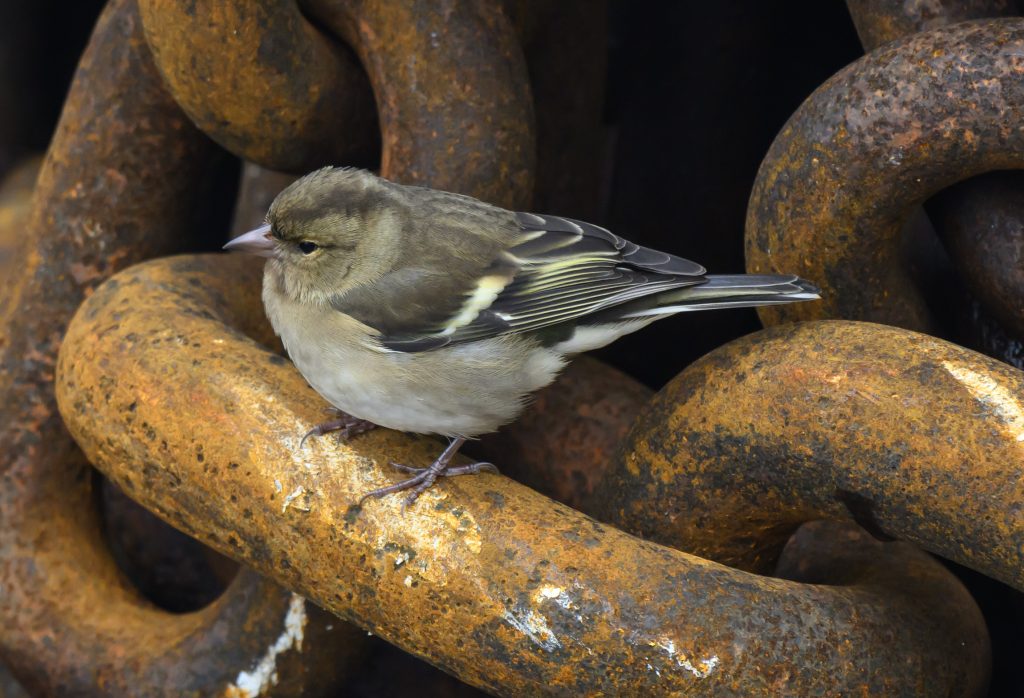
The poor visibility had drawn a few migrants to the ship though, there were three Chaffinch (photo 3) and a Grey Wagtail hopping around on the aft deck. After a while they were joined by a Song Thrush (photo 4).

After an hour or so the fog lifted slightly and we started surveying, visibility was still poor – less than a kilometre – but we could see far enough. Well, we could for 15 minutes then we had to stop again, fortunately, the visibility was in and out so we could start again after 20 minutes. We then managed a further one hour 20 minutes before it closed in again.
Birds were few and far between, we logged just 34 in the time we were surveying, best of which was a couple of Storm Petrels. A flock of seven Redwing circled the ship a few times before disappearing off into the murk.
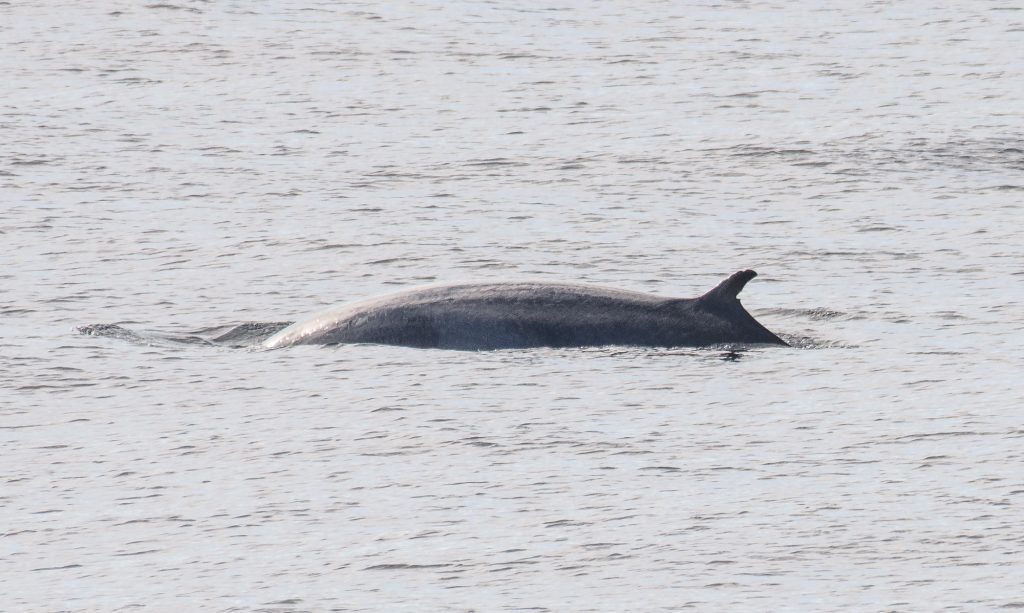
It was a very successful period though; we recorded four species of cetaceans. First up we had a solitary Common Dolphin, then a Minke Whale rolled once several hundred metres ahead (so we didn’t have to wait too long to see on transect). A short time later two Harbour Porpoise were seen in the distance – amazingly the first of the survey.
We’ve had the company of Tim and Sarah, two JNCC observers for the survey. Most of the time they’re out on the bridge wing, a requirement of ESAS bird surveying, but today they’d been forced inside by the conditions. Sarah spotted some large cetaceans off to starboard, a quick look confirmed they Pilot Whales, only the third time they’ve been seen on a Peltic survey. It was also Sarah’s birthday so made her day. I didn’t get photos of either the Minke or Pilot Whales so here a couple of library shots to illustrate them (photos 5 & 6).

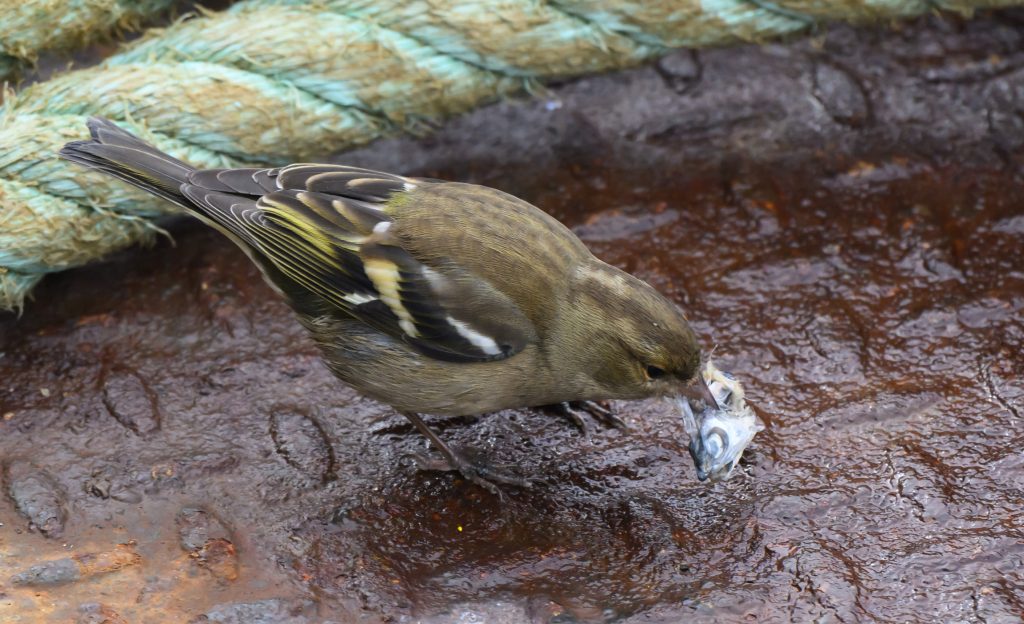
To while away some time while fog-bound I went out on deck to photograph the Black Redstart (photo 7), presumably yesterday’s bird still with us, and the Chaffinch. I was somewhat surprised to see them eating bits of fish from the nets, finches are fed insects as nestlings and they readily come to suet balls, but it was still quite a sight to see a Chaffinch with a fish head in its beak (photo 8).
The weather stayed the same for the next transect and we ended up only able to survey about half of both. Birds were non-existent, with only 17 recorded. Interestingly we had a flock of seven Redwing, this time accompanied by a Grey Wagtail, circle the ship a couple of times, this was about 90km from where we’d had the first flock and were almost certainly the same birds as we had seen in the morning.
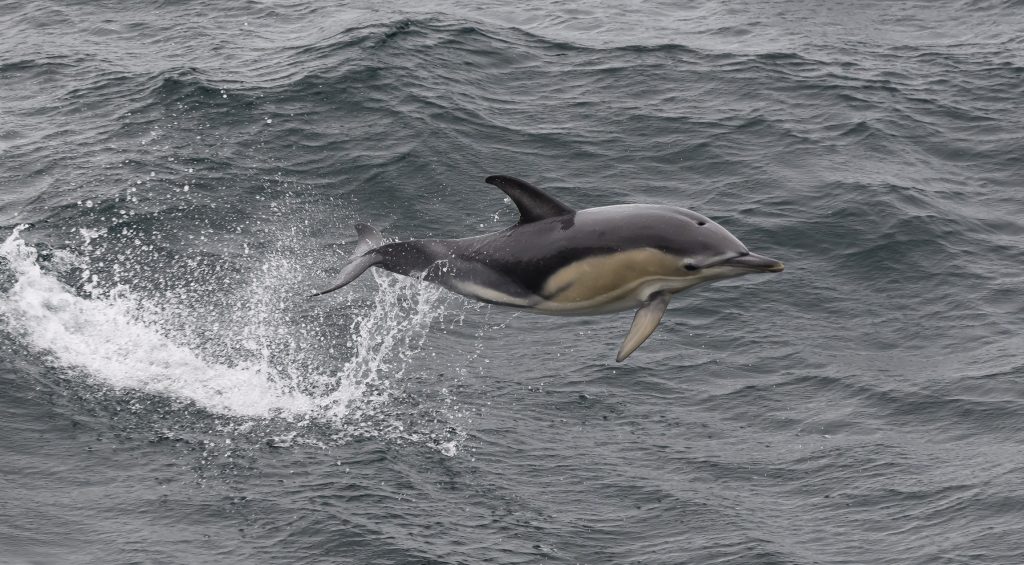
We had a couple of encounters with Common Dolphins (photo 9), including some energetic leaping in towards the bow.
The French coast at Ile Vierge appeared out of the murk at the end of the transect, the tall lighthouse on the island just about visible from a couple of kilometres. With the visibility so poor we were unable to fish during the day, despite plenty of good marks being seen. As the CEFAS scientists really need to try and get a sample from each transect where fish are seen we’ll be returning to these two transects tomorrow in the hope the fish are still about to try again.
Species recorded
Marine mammals
- Common Dolphin 90
- Pilot Whale 7
- Harbour Porpoise 2
- Minke Whale 1
Seabirds
- Auk sp. 9
- Common Gull 2
- Cory’s Shearwater 55
- Gannet 120
- Great Black-backed Gull 17
- Great Shearwater 3
- Great Skua 7
- Guillemot 8
- Herring Gull 2
- Kittiwake 5
- Lesser Black-backed Gull 12
- Manx Shearwater 51
- Puffin 12
- Razorbill 5
- Shearwater sp. 4
- Storm Petrel 7
Inland birds
- Swallow 1
- Grey Wagtail 1
- Redwing 14
- Skylark 1