Activity was immediately evident all around the boat, and the wave skimmers were out and actively searching out for breakfast! Regular small groups of Manx Shearwater appeared running north along the westerly driven wave ridges. They were making a brisk pace on the short sea, swapping one crest quickly for the next, appearing as a steady stream – passing almost as an orderly queue. The view was mesmeric and elegant, watching these streamlined creatures soar effortlessly over such distances, occasionally dipping a beak for refreshment and sustenance.
Intermingled with the skimming shearwaters were many Gannet, searching for food in looping racetrack patterns aligning and intersecting with the wave troughs, and overflying good numbers of auks sitting on the surface or diving, in the backlit morning sun. A scattering of Kittiwake looped and wheeled around in all directions.
Following a tasty breakfast about 7.30, the weather conditions appeared as medium level cloud with a sea state of 3 and good visibility. There was a steady westerly blew, that would increase as we got closer to Ireland, peaking with 40-knot gusts as we closed the Dublin channel!
The only sighting of a pair of Puffin on the surface came shortly after recommencing the survey, but the windy conditions remained great for birds want to soar and the majority of other sightings were of flying birds, mostly of Manx Shearwater, Guillemot, Razorbill, Gannet, and Kittiwake. An occasional Herring Gull and Common Gull started to appear as the Power moved closer to Ireland.
There was one exceptional moment of observation that stood out in the elongating wave troughs as the wind picked up. Two Manx Shearwater were flying as a pair, tracking the same wave crest, when one of them dropped into the downwind trough and executed an upwind climbing manoeuvre to regain the crest they were following. The wave faces were steepening as the sea was short and wind rising, and the other bird which had tracked the crest but was still upwind must have been blindsided by the other climbing bird from beneath, out of the six o’clock position. In an instant, it had rolled completely inverted to avoid its upwardly directed partner. Unable to manoeuvre quickly enough, the climber surged upwards, clipping the other bird as it entered its evasive rolling manoeuvre!
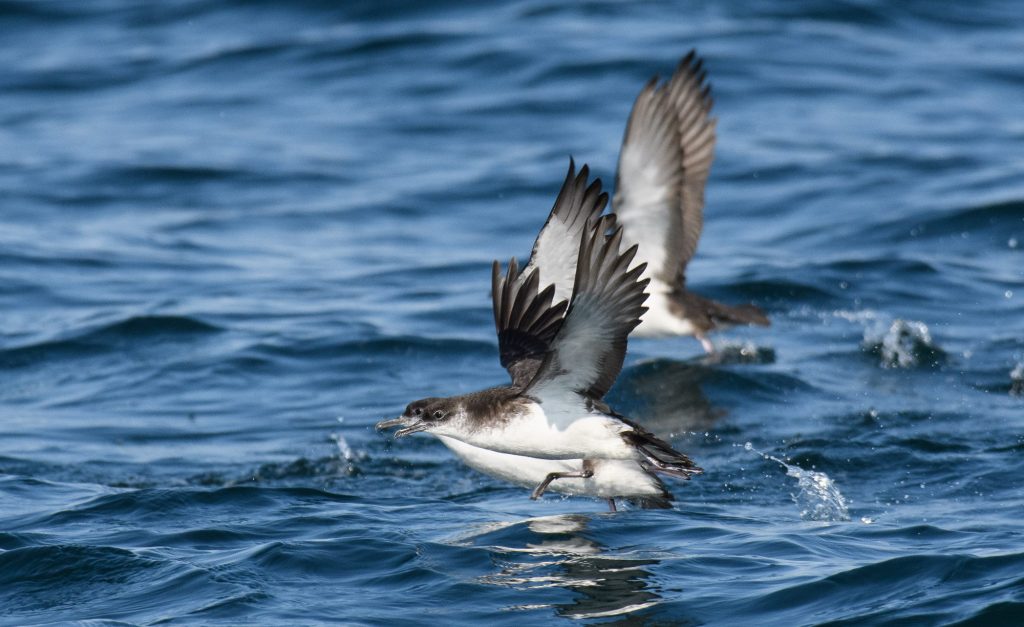
The contact was fleetingly brief, but the rolling bird turned over a full 360 showing a clearly visible white underside! It exited the crest in an upwind direction, while its companion popped up and dived back into the next crest, unaffected! All this as the birds sped along backed by a 30-knot wind speed!! Their reactions were nothing short of amazing to witness and they flew off seemingly unhindered by the event. More evidence of nature’s amazing resilience and maybe an insight as to why shearwaters can live so long?
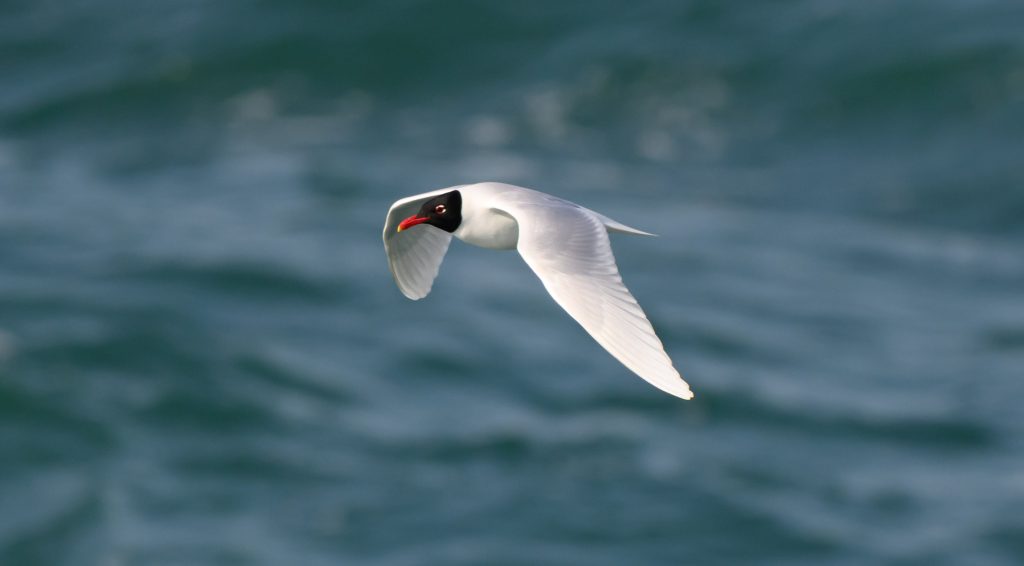
The initial surge of sightings of flying birds seemed to wane with more appearing on the surface in multi-species groups of 100 or so, where most were resting with not much diving in search of food. More juvenile birds became visible as we got into the lieu of Irish coastal waters. As the Power approached the Dublin Harbour channel a number of Shag, Cormorant, and Guillemot appeared, together with a few Common Tern and Arctic Tern, and with the rising wind Dublin Bay held a number of birds seemingly sheltering, including Kittiwake, Black-headed Gull, Common Gull, Great Black-backed Gull, and Mediterranean Gull.
There were no sightings of cetaceans or seals on the outbound trip.
Following a great tasty lunch served by ‘Cookie’ and his galley crew we sailed again at 13.00. The strong weather conditions started to subside as the wind steadily dropped and the grey clouds parted. The forecast rain never actually appeared, and the sun even made an appearance but not enough to warm or create any glare.
Leaving the harbour, there were good conditions for feeding birds in the channel, with large number of gulls and terns, wheeling and dropping into the agitated water between the four ships leaving the port line astern. It clearly showed the advantage the surface and shallow feeders take of ship’s propwash effect on the shallow water column. The several Cormorant and Shag seemed to sit off to the side more, picking off the fleeing prey species deeper in the stirred-up area, along the border of the sediment cloud that was clearly visible in the channel.
Most sightings on the return trip were of smaller groups, both floating and flying in similar numbers but with less visible feeding activity and the axis of travel had changed to a southerly direction from the earlier northern one. The wind direction had not noticeably changed though, and it was unclear if this was down to time of day or because of less foodstuffs present.
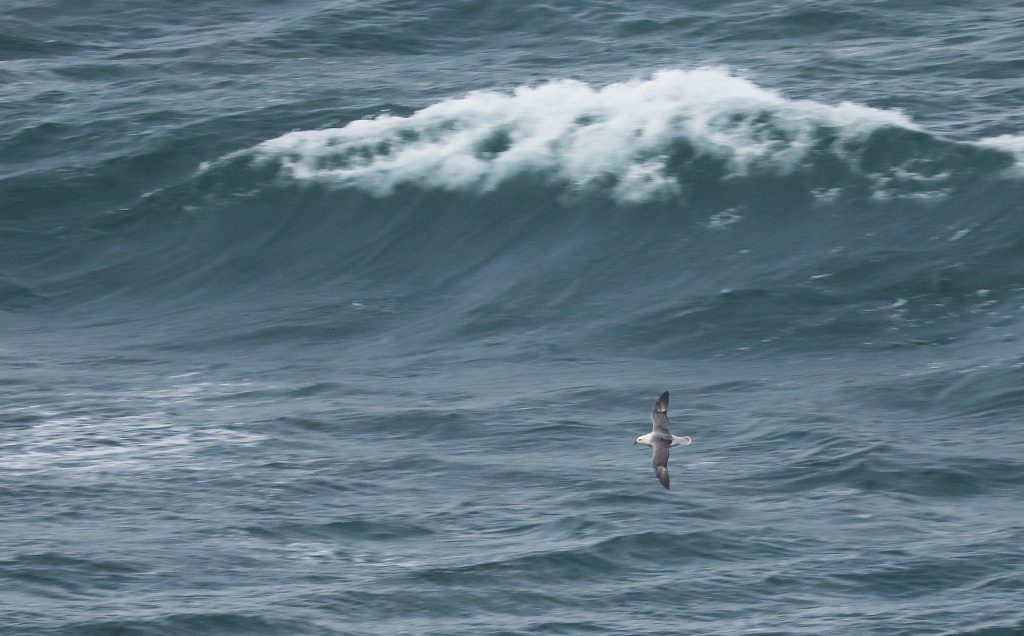
One species, noticeably absent on the survey until this time then made an appearance – a dark morph Northern Fulmar clattering past as if to show that it is the best of the wave skimmers now flying! As if on cue, over the next few hours into the evening several more appeared, of differing morphs.
The dropping wind was obviously not just affecting pelagic species! One of the crewmembers pointed out a racing pigeon that appeared on the rear upper workings of the Power, resting on the railings. After about 30 mins or so rest, it lifted off, circled the vessel twice, and headed off eastward towards Liverpool and the Dee peninsula. This wasn’t the only hitch-hiker present on the crossing, as a juvenile/2nd year Herring Gull sat on the rear stack of the vessel from Dublin until we were running parallel to the south Cumbrian windfarm, before flying off northward.
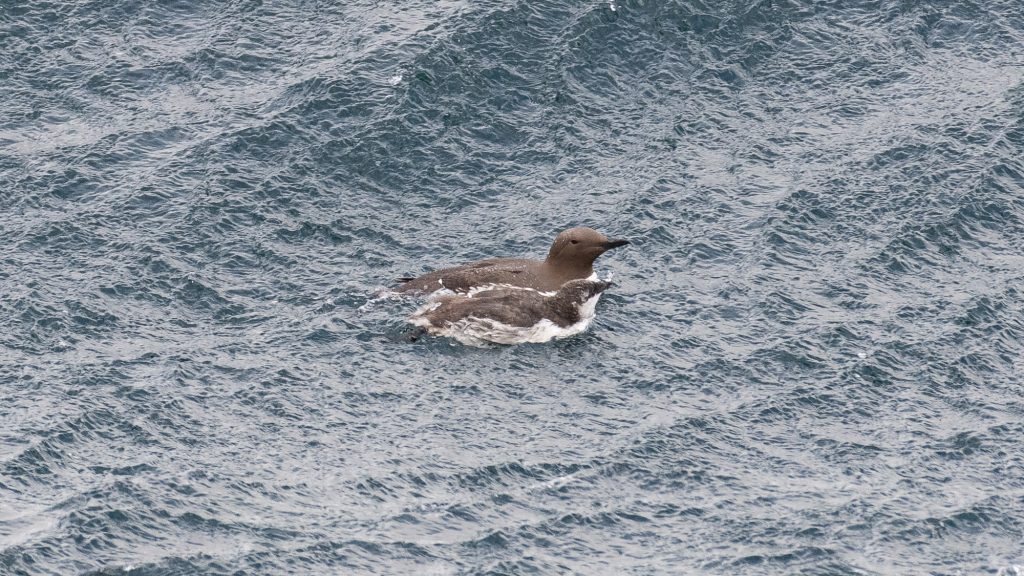
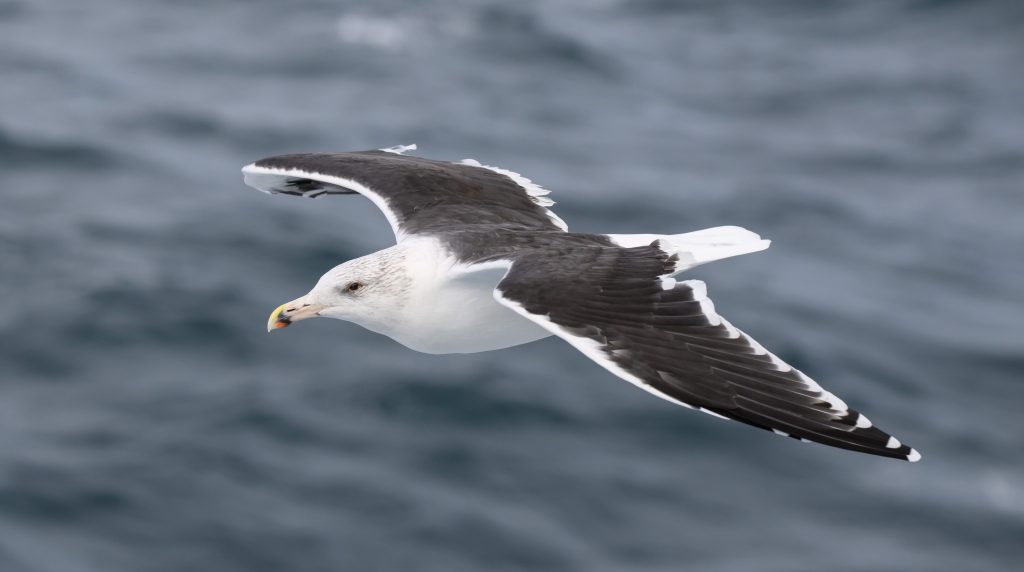
South of the windfarm and into Morecambe Bay, larger groupings of Guillemot with their young jumplings became visible, in groups of up to 50, while there were also numbers of Greater Black-backed Gull and Lesser Black-backed Gull in mixed groups in the same area, perhaps looking for an easy meal of Guillemot jumpling? The correlation is possible.
On the return to Heysham in mid-late afternoon, a couple of small pods of Common Dolphin were briefly sighted, breaching and running in for a quick bow ride. As we entered the waters of Morecambe Bay proper, another single dolphin breached and was gone, that was the end of any sightings. Surface conditions were maybe not the best and only a single pair of eyes probably missed others.
A delicious tea was served around 5 and surveying then continued into the evening until 9.45 as light faded into the Lune Deep. Numbers of Gannet continued to appear into the evening, along with a sudden flurry of six Northern Fulmar skipping past, with a mixture of light and dark plumages. The rest of the passage seemed to be a slow stream of Guillemot and Razorbill, and the survey ended just short of the Heysham breakwater in an exceptionally clear evening light.
I was very well looked after and made welcome by Captain Karm, the stewards and crew alike, and all were very accommodating and helpful as always. The ship is immaculate and runs like a well-oiled machine. All this really does make these surveys possible and a pleasure to do, a big thank you to CLDN for their continued support.
Jon Steele, Research Surveyor for MARINElife (Registered Charity No. 1110884; Registered Company No. 5057367)
Weather
Outbound: Sea state 3-4; Visibility 5-6; Clouds 4-8; Swell 1-2m; Wind W 21-35 knots
Return: Sea state 2-3; Visibility 5-6; Clouds 4-8; Swell 1-2m; with Wind W-SW 10-19 knots
Species recorded
Marine mammals
- Common Dolphin Delphinus delphis 6
- Unidentified Dolphin sp. 1
Seabirds
- Auk sp. Alcidae 106
- Black Guillemot Cepphus grylle 2
- Common Gull Larus canus 50
- Common Tern Sterna Hirundo 5
- Cormorant Phalacrocorax carbo 3
- Fulmar Fulmarus glacialis 6
- Gannet Morus bassanus 76
- Great Black-backed Gull Larus marinus 2
- Guillemot Uria aalge 124
- Gull sp. Laridae 27
- Herring Gull Larus argentatus 36
- Kittiwake Rissa tridactyla 116
- Lesser Black-backed Gull Larus fuscus 11
- Manx Shearwater Puffinus puffinus 719
- Mediterranean Gull Ichthyaetus melanocephalus 2
- Puffin Fratercula arctica 4
- Razorbill Alca torda 33
- Shag Gulosus aristotelis 10
- Shearwater sp. 2
Inland birds
- Heron sp. Ardea 1
- Rock Dove/Feral Pigeon Columba livia 1